How AI Blew Up Chess
.png)
This week at Hadrius HQ, an office-wide chess game spontaneously broke out.
A few days ago, someone set up the board for a game (one of our favorite pastimes) but never returned. Someone walking by made white’s opening move; someone else replied as black.
More anonymous moves followed. Before long, a paper towel marking whose turn it was appeared. The office was playing itself in chess.
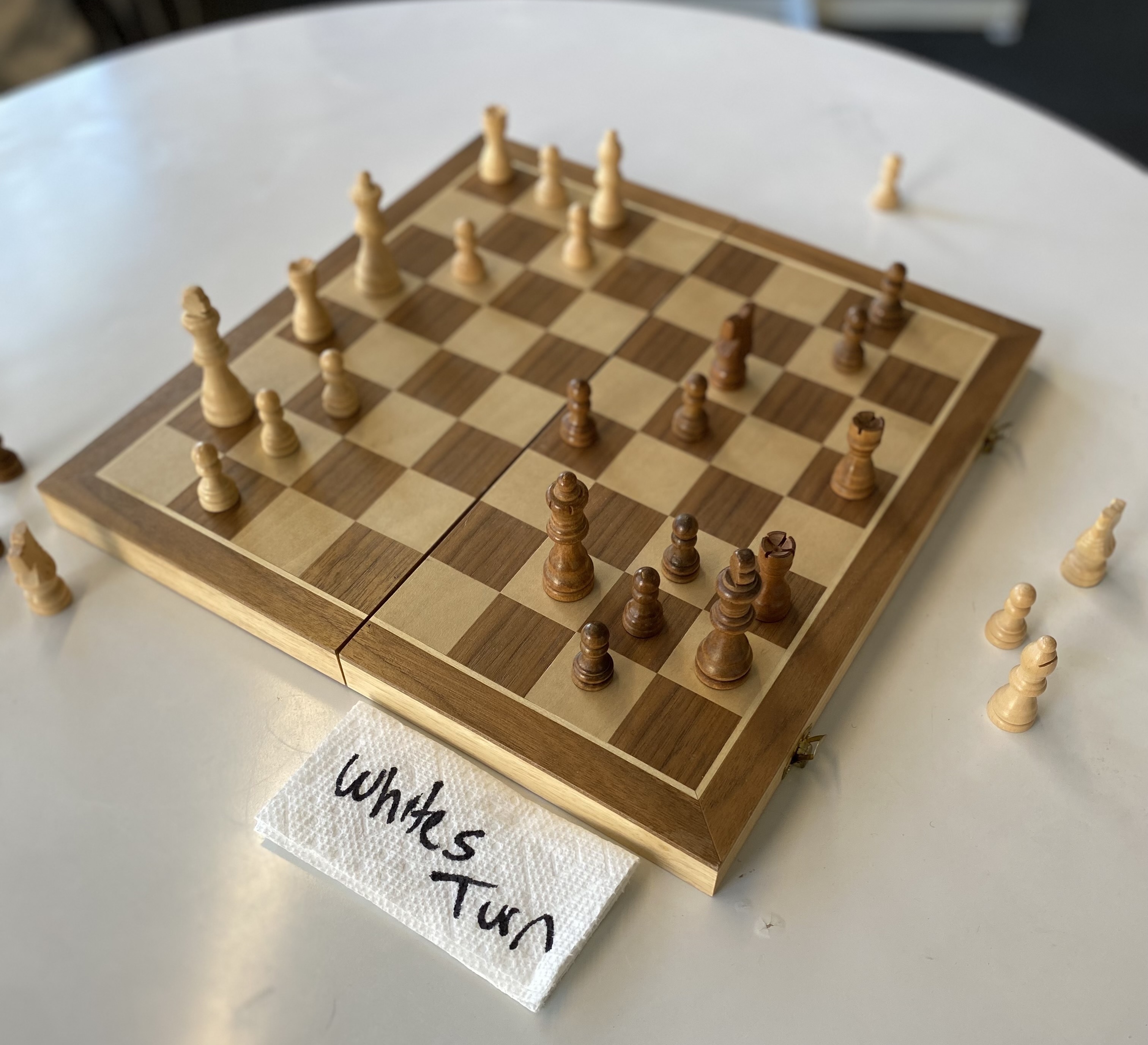
As a chess fan, I love that Hadrius is the kind of place where someone’s always down for a game after shutting the laptop for the day. It also reminded me of an often-overlooked aspect of chess: the game’s recent history is a perfect illustration of how AI can empower humans and human activity, even when it eclipses us in ability.
The AI takeover of chess
In 1997, IBM’s supercomputer Deep Blue beat world champion Garry Kasparov in a six-game chess match. Though the computer didn’t use the kind of deep learning behind our current era of artificial intelligence, it was a watershed moment for AI: the first time a computer beat the best chess player in the world. Prior to the match, some observers wondered if the feat would ever be possible. After, a lot of the same people wondered if chess was done for.
For centuries, chess had been regarded as a test of human intelligence. What would become of the game if it no longer belonged to human genius? What would be its… point?
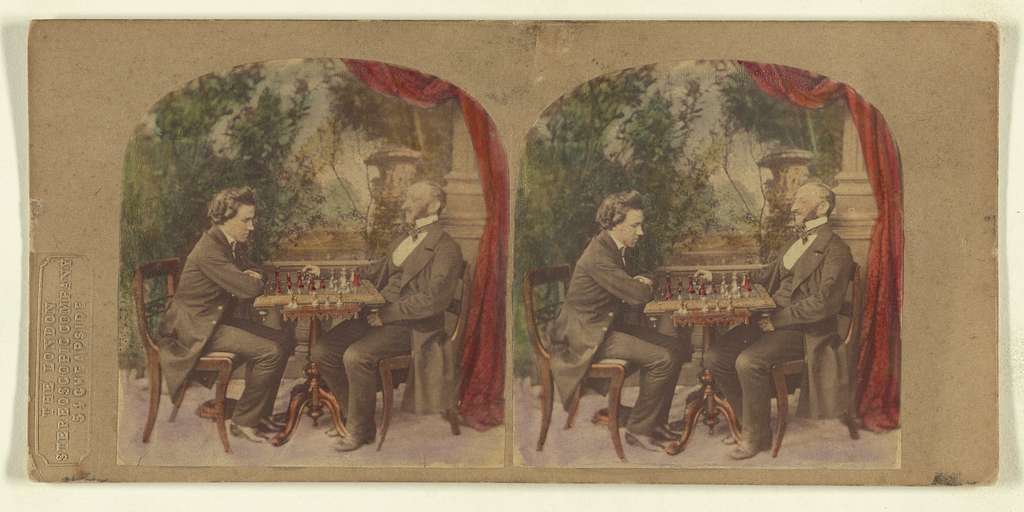
A real-time scoreboard
What actually happened when AI took over chess was the exact opposite of those fears: the game became more popular than ever, its popularity driven by precisely the fact that computers are now better than we are at chess.
Yes, humans lost dominion over a pastime we had invented. The best human player in the world is significantly weaker than a chess engine that even a smartphone could run. But here’s the critical point: AI being better than humans at a task gives humans a power they didn’t have before.
Chess is a complicated game — so complicated that, in most positions, no machine on earth is powerful enough to compute with certainty which move is best. Chess engines go through a process of calculation and estimation much like humans do; computers are just better at it. (This is only true in relatively simple, bounded domains like a board game. In more complex situations, humans remain superior judges.) Before chess engines, grandmasters could analyze (and debate!) a given position for days trying to determine the best move.
AI changed that. Now we have access to not only superior chess ability, but instant superior ability.
Imagine you're watching a big chess game. (Yes, there are fans who do this.) One player makes a move. Was it a good move? What could the other player reply with? In previous eras, answers to these questions were unclear without very slow, laborious study.
Today’s chess engines give us something called an evaluation bar: a simple diagram showing the audience (not the players) how good the move was. This evaluation bar is the output of an engine that also shows the best series of moves that should be played in response. Because the AI is so much better than any human, this machine opinion on the chess position is regarded as “correct”: not mathematically perfect, but close enough for human purposes.
AI, in other words, gave chess a real-time scoreboard.
This scoreboard has been critical for expanding the popularity of chess. Events featuring top players are now broadcast online as a kind of sport, complete with live commentary that leverages a combination of human and machine intelligence to show viewers exactly what’s happening in a game that would otherwise be opaque.
In addition, AI has made learning chess accessible. Newcomers to the game can access virtual coaching that rivals what only privileged chess learners had access to in generations past. Talented young players are more competitive at earlier ages. AI has even changed the way grandmasters play chess; the engines are showing and proving highly creative new ideas that have made their way into the world’s top tournaments.
Chess is still human
Humans have this funny ability to make everything about us, even when we’re using technology to take over work we used to do. Invent a telephone and it empowers more conversations; invent GPS and it helps us explore more places.
AI did take over chess. The era when a human player could feel egotistically superior to a computer is over. But AI did not colonize chess. The game still belongs to people. The fact that a computer could easily beat Magnus Carlsen or Hikaru Nakamura is not interesting. What’s interesting is watching Magnus and Hikaru play each other. And when that happens, AI helps us enjoy it.
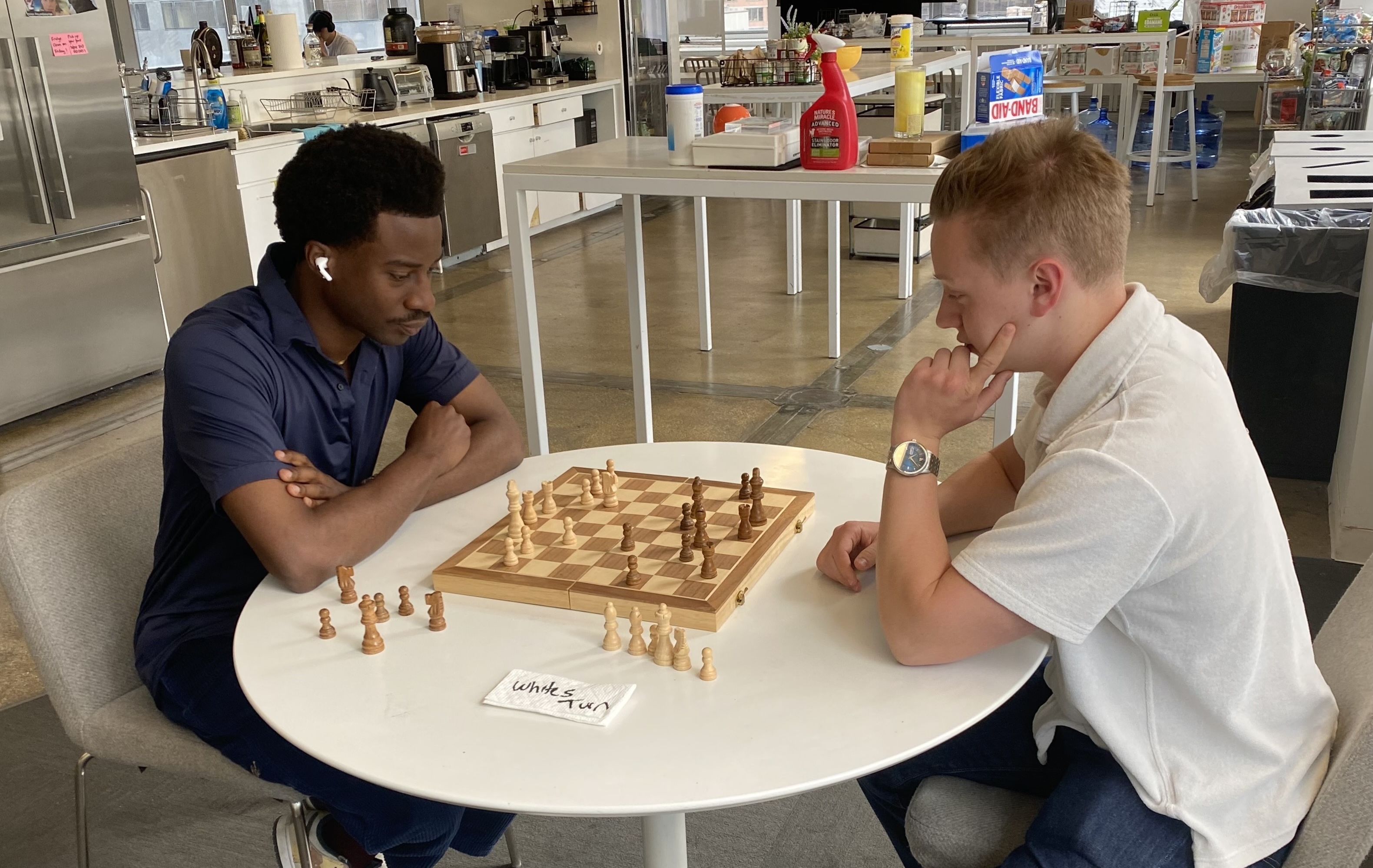
Here in the Hadrius office, chess exists as it has for centuries: as a wooden board that two people place on a table between each other. (See above.) It’s an after-work pastime; a break from technology.
When we’re on the clock, we build products that use artificial intelligence to help compliance officers spend their time more efficiently and review more confidently. Our goal is to automate the work that people used to do, but no longer have to do. It’s technology that helps you use less technology, and spend more time doing those offline activities that take place nowhere near a screen.
Want to join a team that knows how to party? Visit our Careers page.
Insights that Move Compliance Forward
Explore new ideas, proven strategies, and technology that’s transforming how firms stay compliant.
Related articles


.png)

We are Hadrius.
Hadrius is built for financial services compliance teams that demand more from their technology. Our privacy-first, policy-aware AI compresses review cycles, eliminates noise, and produces regulator-grade evidence on demand.
One vendor. One system of record.